Chapter 4 & 5: Probably Should Be Read Together
Daniel Chapters 4 and 5 forms the core of the structural unit that comprises Chapters 2 thru 7. As such chapters 4 and 5 provide contrasting examples of royal hubris or extreme haughtiness, pride or arrogance. In chapter 4, Nebuchadnezzar eventually comes to recognize that 'the Most High God is the true sovereign and rules over human kingship. Because of this understanding and recognition Nebuchadnezzar is restored to his throne.
Conversely, Belshazzar having Nebuchadnezzar’s example to learn from being his descendant has learned nothing from the example which the narrative in chapter 5 assumes he knows, hence the linkage...so he loses his throne and then his life as both are God's. The author of chapter 5 is even specific of this comparison by mentioning Neb’s in verses 2 & 11 to make sure the reader sees the comparison/contrast. They both therefore share the idea that God’s judgment or wrath is directed at human pride that sets itself up against God. Nebs’ pride arose from his achievement(s), Bells’ arose from his lack of achievements.
These two combined and their intended contrast should structurally be seen as the climax of the unit containing chapters 2 thru 7. The moral of the story or overarching theme is that of royal hubris or extreme haughtiness especially when it is waved in the face of the Most High God...it leads to disaster. This then paves the way for the visions in chapters 8 thru 12 which to some extent speak to the rise and fall if kingdoms until the ultimate one comes...God's
Overall chapters 3, 4 and 5 are closely interrelated. The story leaves Nebuchadnezzar 'half-converted'. He recognizes the power of the God of Shadrach, Meshach and Abednego, but still thinks that he can manipulate this power to some extent by prescribing which God people should worship. In chapter 4 we see the completion of his conversion as his pride is humbled and he ends up simply confessing the greatness of God. These two stories (Chapters 4 & 5) thereby form a pair that contrast one another since both describe the humbling of arrogant leaders/kings.
Nebuchadnezzar “gets it”, Belshazzar “doesn’t get it” therefore Belshazzar deserved the calamity that befalls him. As the Professor McLaughlin notes: ”Pride goes before destruction, a haughty spirit before a fall.” Proverbs 16:18
What Does Daniel Praying in an Open Window Tell Us Today? (Chapter 6)
The key is the term 'law' in this story. There is competing demands on Daniel (and believers like us) of the “Law of God” and the “law of the land”. In the case of Daniel it is the “law of the Medes/Persians”. There is also the idea of a divine sovereignty that overarches everything. Even though Darius is tricked into making a law which forces him to comply with throwing Daniel into the lion’s den. Undeviating, God’s sovereignty and control of things can make that law ineffective and essentially a “paper lion” or a “lion without teeth and claws”. In this story there is even the supposed immutability of the “law of the land/men” with the Medes and Persians that even the supposed all-powerful king cannot overturn it…but God can.
Furthermore, we see the idea relevant to today, that the State might/may claim for itself a quasi-divine type of distinction. Boy!...This this damning for us today in the United States and to some extent many “sovereign” nations in the world. Especially today in times of increasing crime rates, economic problems, growing social unrest or external threats that appear to be the divine judgement of a just God. In the supposed absence of a tangible or physical God, citizens of kingdoms or nations willingly afford quasi-divine status on their government (i.e: Nanny State). The State becomes God…and if this sounds strangely familiar it is because it is the premise to some extent for Communism, Fascism and to a milder degree Socialism. When this happens, it causes a need to divide loyalties to either State or God. This presents problem to those the wish to worship the One True God. As history has shown, the State will sooner or later make demands that challenge allegiance to God whether openly or subtly. We saw it all through the centuries and especially in the 20th…and we see it now. These subtleties mentioned often come in the form of a governed of mandated “political correctness” that inevitably make it a crime to obey one’s God or worship Him openly. Eventually certain expressions of belief, or moral stances, are no longer culturally acceptable. Two of the more recent issues forcing a divided loyalty in our culture right now are homosexual marriage and abortion due to laws being passed by the government against the concept and edicts clearly outlined in the Bible.
When presented with this choice Daniel and believers like us are called to obey God even if it is a violation of the “laws of the land” / ”law of the Medes and Persians”. As Daniel understood and we should also, obeying God saves us, obeying the laws of man and the precepts of this world condemns us because in the long-view…this world is fallen, corrupt and prone to a continual reprobate nature. We must delineate or separate ourselves from the world in these instances. We are to engage and interact with the world…we are not to become it.
Romans 12:2 “Do not be conformed to this world, but be transformed by the renewal of your mind, that by testing you may discern what is the will of God, what is good and acceptable and perfect.”
If men and their laws try to usurp God, God and His decrees trump men. Period…end of discussion. "Man cannot serve two masters."
We must also remember that earthly powers do have some power over us, the people of God. We must remember that the faithful like Daniel are not saved from the lions den but rather in the lions den. Shadrach, Meshach, and Abednego are not saved from the fiery furnace but rather in the fiery furnace.
Makes one think...doesn't it? Its a matter of timing.
God's not yours.
It is quite possible that God wants you to be a martyr. Probable? No. Possible? Yes.
The Christian Worldview -vs- The Pagan View (Chapter 7)
Daniel 7 and Psalm 2 parallel one another thereby showing unity in the book of Daniel in spite of language differences.
First it must be stated that Daniel 7 being a break in the ethos of the first part of Daniel 1-6 and then 7-12 is not because of contradictory worldviews. Instead, it represents two ends of the same spectrum of the experiences of the godly person living in a pagan ungodly society. As such Daniel 7 attempts to convey ideas through culturally based symbolic imagery because it communicates in ways beyond normal prose. In the proper context these symbols carry with them powerful communication and ideas or a “punch”. Outside of their proper context they make nearly no sense and are absolutely bewildering. This makes it imperative that we understand the culture they were written in and to.
If these imageries are based in the Babylonian Creation epic which they very well may have been they are quite possibly alluding to the imagery or “feel” or chaos, conflict and creation. It is a form of chaos that ends in renewal and order for another sustained period. From a Hebrew point of view and to another extent Christian the stability of the world is guaranteed by the fact that Yahweh created and is in control of the Creation.
Say among the nations, "The LORD reigns." The world is firmly established, it cannot be moved; he will judge the peoples with equity. Psalm 96:10
The Creation epic is expounded upon on in Genesis 1 and 2 and is further elaborated on in Psalm 74:13-17
“You divided the sea by your might; you broke the heads of the sea monsters on the waters. You crushed the heads of Leviathan; you gave him as food for the creatures of the wilderness. You split open springs and brooks; you dried up ever-flowing streams. Yours is the day, yours also the night; you have established the heavenly lights and the sun. You have fixed all the boundaries of the earth; you have made summer and winter."
Believers are/were confident that God (the Creator) could deal with all forces in a Creation that He created and controls by His sovereign hand. Some of these forces were historical and by their nature…human in origin and this is where the parallel to Daniel 7 is best seen…in Psalm 2:1-2
“Why do the nations rage and the peoples plot in vain? The kings of the earth set themselves, and the rulers take counsel together, against the LORD and against his Anointed, saying ~ Psalm 2:1-2
Hebrews (and Christians) are sure that Yahweh can and will deal with these forces and Psalm 2 shows us that it will be done through the Messiah (His Anointed). God will not let His faithful languish forever (in exile or sin) nor will He fail to have the power to save and redeem His people (from the yoke of slavery and oppression to the Babylonians, the Medes, the Romans, sin…themselves. Those that remain faithful and repentant to the bitter end will not only see, but they will also share as co-heirs in Christ in the culmination of all of God’s sovereign purposes at the End of the Ages. AMEN!!! GOD NEVER ABANDONS HIS FAITHFUL!!!
February 13, 2012
February 12, 2012
Scars From Romans
- The Cross shows the love of God for what it is...It is gracious, merciful (for us), longsuffering and abundant and/or overflowing from the Fountainhead of Love itself -- God.
- The Cross also shows sin and evil for what it is...It took the death of the Son of Man to put it away forever
- The Cross tells us as Christians that we do not live defeated lives but are victorious in the Lord.
- We were once children of wrath but we are now saved by the blood of the Lamb.
- The Lamb who is the Son of God.
- A promise to Abraham [and us] or to his descendants that he would be heir of the world was not through the Law, but through the righteousness that comes by faith.
- More specifically through righteousness of faith - διὰ δικαιοσύνης πίστεως
- Righteousness...that had to have been given to us from a righteous source
- A source that cared enough to do so...
- Because we are not righteous--no, not one.
- Faith or trust that God does what He promises.
- Ultimately, what He promised is righteousness-holy like He is holy.
- Without which there is no eternal life.
- Faith, not an act of seeing but rather the eye that believes without seeing.
- Faith or the belief given to us by God.
- Given through grace
- So we may remain obedient to the faith
- Those that are righteous will live by this faith
- Without Christ...none of this is possible
- Because Jesus Christ was the promise
- More specifically He was the "Promised One"
- Of which both the Law and the Prophets spoke of all those ages before.
- Having been justified by faith- we have peace through Jesus Christ.
- We are no longer under His wrath.
- By which we have been introduced by faith into this [God's] grace where we now stand-and exult in the hope of the glory of God
I am so wretched.
February 11, 2012
Christianity & The Bible: Perfect Quality System III - Correcting Non-Conformities
Sometimes a church looses its way and it is hard to get it back on course. The Bible calls us to corrective actions otherwise...
"...other seeds fell on rocky ground, where they did not have much soil, and immediately they sprang up, since they had no depth of soil, but when the sun rose they were scorched. And since they had no root, they withered away." ~Matthew 13:5-6
I think what I found most surprising when doing this post is my research. I went on the internet and looked for what others felt were the corrective actions for fixing a church that has "turned to the right or the left" (Proverbs 4:27) and almost all of them made suggestions for corrective action that were devoid of Scriptural support! Dude! That makes me batty! Many made statements like: "The church must maintain its relevance...blah blah blah" or worse...they stated that we need to, "make sure the muffin and coffee table are in an accessible and user-friendly position." Still more said things reductio ad absurdum like: "We need to focus inwardly..." or make a priority of "comfort". Whaaaa? Will someone please show me in the Bible where it says this? Please..anyone. This builds Christians in their walk with Jesus Christ how?
The Bible tells us nearly the opposite:
Luke 9:23 ~"Then he said to them all: “Whoever wants to be my disciple must deny themselves and take up their cross daily and follow me."
Philippians 1:27-29 ~"Whatever happens, conduct yourselves in a manner worthy of the gospel of Christ. Then, whether I come and see you or only hear about you in my absence, I will know that you stand firm in the one Spirit, striving together as one [not alone inwardly] for the faith of the gospel without being frightened in any way by those who oppose you. This is a sign to them that they will be destroyed, but that you will be saved—and that by God. For it has been granted to you on behalf of Christ not only to believe in him, but also to suffer for him, since you are going through the same struggle you saw I had, and now hear that I still have.
First and foremost we need "to preach the Gospel"! εὐαγγελίζεσθαι !!! Once we get this down, then we can move forward tentatively with additional corrective actions. The first thing we should be doing is rooting out and disposing of the underlying sinful mindsets. The Bible is clear that our actions have their impetus in out thought world. Where the mind leads the body will most assuredly follow.
Matthew 5:21-22~ “You have heard that it was said to the people long ago, ‘You shall not murder, and anyone who murders will be subject to judgment." But I tell you that anyone who is angry with a brother or sister will be subject to judgment.
Matthew 5:27-28~ "You have heard that it was said, ‘You shall not commit adultery." But I tell you that anyone who looks at a woman lustfully has already committed adultery with her in his heart.
...and so on.
The Corrective Action in aNon-Conforming Church
Reorientation to a Biblical Standard
Check:
We need to continue to consult the Scripture until we die. Over and over and over and over ad nauseum if need be. None of us are good enough to just read it a few times and walk away. This is where many churches and leadership stop either willingly or because they have reached a point of denial. By this I mean that leadership believes they have finally "made it" or they begin to become pharisaic and start answering to their own standard therefore abandoning Scripture. They believe they "know" Scripture as well as they should and therefore no longer consult it. This is no different than apostasy as we, in our depraved sinful nature begin to think or say, "Oh, the Bible says this when I read it ten years ago...". What did Jesus say? "It is written..." He always consulted the Bible directly. Believe me, I serious doubt Jesus forgot Scripture or twisted it. Jesus was the WORD! He said this as a model or benchmark for our behavior!
Benchmark:
In closing I will state this: Although it isn't explicitly stated in this post, it is most certainly implied. This must all be done in love and with a firm hand. Tough love when necessary. Tough love means telling people the truth...even when the truth hurts. If I didn't love people, I would lie to them and soften the edges. There is no room in this world for a watered-down Gospel. When you are telling the truth of God there is no such thing as not delivering the truth in love because God's truth is love! Also, through all of this including the consultation of Scripture we should be praying. Taking our issue right to the throne of God. It is a double-check system to assure that we are in alignment with God's overall plan for holiness. We have the Word and we have the relationship. It is an airtight process to sanctify us as we adhere to Him...(dare I say it)...religiously, with devotion and conviction. ;)
"...other seeds fell on rocky ground, where they did not have much soil, and immediately they sprang up, since they had no depth of soil, but when the sun rose they were scorched. And since they had no root, they withered away." ~Matthew 13:5-6
I think what I found most surprising when doing this post is my research. I went on the internet and looked for what others felt were the corrective actions for fixing a church that has "turned to the right or the left" (Proverbs 4:27) and almost all of them made suggestions for corrective action that were devoid of Scriptural support! Dude! That makes me batty! Many made statements like: "The church must maintain its relevance...blah blah blah" or worse...they stated that we need to, "make sure the muffin and coffee table are in an accessible and user-friendly position." Still more said things reductio ad absurdum like: "We need to focus inwardly..." or make a priority of "comfort". Whaaaa? Will someone please show me in the Bible where it says this? Please..anyone. This builds Christians in their walk with Jesus Christ how?
The Bible tells us nearly the opposite:
Luke 9:23 ~"Then he said to them all: “Whoever wants to be my disciple must deny themselves and take up their cross daily and follow me."
Philippians 1:27-29 ~"Whatever happens, conduct yourselves in a manner worthy of the gospel of Christ. Then, whether I come and see you or only hear about you in my absence, I will know that you stand firm in the one Spirit, striving together as one [not alone inwardly] for the faith of the gospel without being frightened in any way by those who oppose you. This is a sign to them that they will be destroyed, but that you will be saved—and that by God. For it has been granted to you on behalf of Christ not only to believe in him, but also to suffer for him, since you are going through the same struggle you saw I had, and now hear that I still have.
First and foremost we need "to preach the Gospel"! εὐαγγελίζεσθαι !!! Once we get this down, then we can move forward tentatively with additional corrective actions. The first thing we should be doing is rooting out and disposing of the underlying sinful mindsets. The Bible is clear that our actions have their impetus in out thought world. Where the mind leads the body will most assuredly follow.
Matthew 5:21-22~ “You have heard that it was said to the people long ago, ‘You shall not murder, and anyone who murders will be subject to judgment." But I tell you that anyone who is angry with a brother or sister will be subject to judgment.
Matthew 5:27-28~ "You have heard that it was said, ‘You shall not commit adultery." But I tell you that anyone who looks at a woman lustfully has already committed adultery with her in his heart.
...and so on.
The Corrective Action in a
Reorientation to a Biblical Standard
Check:
- If there is either a reluctance or unwillingness to at least enforce or maintain a minimum behavioral or quality standard in a congregation there is a problem with sin or influence of iniquity already within the Body whether it be in thought or action.
- For example: If there is a problem with quality of output in terms of marriages, sexual propriety/impropriety or immorality the root cause of these sins will also be sexual or relational in nature.
- The end result will often be leadership wondering by leadership why output quality (marriages, sexual propriety/impropriety or immorality) is not up to or down to expected levels respectively at the point of measurement.
- Marriages
- Discipleship
- Spiritual Life
- We as a church must delineate what we are by defining what we are according to a biblical standard. If we maintain or allow the standards of the world or culture wholesale through the front door of the church if not by the laity, then by the leadership itself sometimes we will become the culture. Even precursory review of the culture can see that the culture seriously messed-up. It is messed up becuase:
- It has abandoned God and the Bible.
- It therefore has no absolute moral benchmark or absolute measure of Truth
- If we reject Bible truth, we reject God because God is Truth.
- I am the Way, the Truth, and the Life ~John 14:6
- Therefore mankind makes its own benchmark and it is based in human logic and human reason which is a recipe for disaster and further apostasy (fall away from God).
- We've seen all throughout the Bible the endgame of man putting himself in the place of God.
- Thou shalt have no other God's before Me....Exodus 20:3
- Failure to obey this incurs judgment and curses of Deuteronomy 28.
- If we rarely (perhaps never) check some of the sins at the door and we wonder why the church appears to be stagnating relationally both in marriages and with covenant with God
- The church therefore becomes the same or indistinguishable from the outside.
- This is a problem because it is a non-conformity to a Godly standard outlined in Scripture
- We are expected to change after we have entered the Faith.
- "Or do you not know that wrongdoers will not inherit the kingdom of God? Do not be deceived: Neither the sexually immoral nor idolaters nor adulterers nor men who have sex with men nor thieves nor the greedy nor drunkards nor slanderers nor swindlers will inherit the kingdom of God. And that is what some of you were. But you were washed, you were sanctified, you were justified in the name of the Lord Jesus Christ and by the Spirit of our God" 1 Corinthians 6:9-11
- We as a church must delineate what we are. Are we running a church or running a business or a business running a church? We can use ideas from the business world to help our churches as long as they align perfectly with the Bible but we cannot run our churches as businesses! (Take that Rick Warren :) We can't have our cake and eat it too. No man can serve two masters. "No one can serve two masters. Either he will hate the one and love the other, or he will be devoted to the one and despise the other. You cannot serve both God and Money." Matthew 6:24
- We must start with a basic minimum expectation of behavior.
- If we were running a business which many evangelical church models are based on, then, just like every other business in the world, implement a minimum standard level of Human Resource quality by enforcing a...
- Dress Code
- Minimum Acceptable Behavior standard
- Make proper interpretation of Bible the benchmark
- First, assure that leadership (and their spouses ,as they are de facto leaders) have a correct view of Scripture.
- Second, Assure through aforementioned biblical leadership that laity have a correct view of Scripture
- Implement Biblical training and education where necessary to improve the minimum level of sanctification and holiness.
- If were running a church then implement a minimum level of holiness to allow for productive environment for a minimum level of sanctification.
- Dress Code
- Minimum Acceptable Behavior standard
- Make proper interpretation of Bible as the benchmark
- First, assure that leadership (and their spouses ,as they are de facto leaders) have a correct view of Scripture
- Second, Assure through aforementioned biblical leadership that laity have a correct view of Scripture
- Implement Biblical training and education where necessary to improve the minimum level of sanctification and holiness.
- Either way, business or church, both demand a minimum level of quality for them to function at even a nominal or "functional" level.
- Why do we need that minimum standard? Is it a "work"? NO!
- "Therefore, if what I eat causes my brother to fall into sin, I will never eat meat again, so that I will not cause him to fall." ~1 Corinthians 8:13
- "Do not cause anyone to stumble, whether Jews, Greeks or the church of God" ~ 1 Corinthians 10:32
- "And whoever causes one of these little ones who believe to stumble, it would be better for him if, with a heavy millstone hung around his neck, he had been cast into the sea." ~Mark 9:42
- "It is better not to eat meat or drink wine or to do anything else that will cause your brother or sister to fall." ~Romans 14:21
- If not, you just have a broken business/church with little or no acceptable cut-off or standards.
- Therefore they're just like everyone else.
- Therefore they are the culture. That my friends...isn't biblical
- No true believer would intentionally set a snare in order to cause confusion for those who seek the Lord.
- No true believer would intentionally lead a fellow Christian away from truth.
- No true believer would intentionally lead their children to rebel against God and not believe and obey the Bible.
- No true believer, wife or husband would deliberately do things to cause their spouse to fall
- No true believer would deliberately, intentionally and openly sin against God in front of another believer without conscience.
We need to continue to consult the Scripture until we die. Over and over and over and over ad nauseum if need be. None of us are good enough to just read it a few times and walk away. This is where many churches and leadership stop either willingly or because they have reached a point of denial. By this I mean that leadership believes they have finally "made it" or they begin to become pharisaic and start answering to their own standard therefore abandoning Scripture. They believe they "know" Scripture as well as they should and therefore no longer consult it. This is no different than apostasy as we, in our depraved sinful nature begin to think or say, "Oh, the Bible says this when I read it ten years ago...". What did Jesus say? "It is written..." He always consulted the Bible directly. Believe me, I serious doubt Jesus forgot Scripture or twisted it. Jesus was the WORD! He said this as a model or benchmark for our behavior!
Benchmark:
- We are called to be different and we are to hold ourselves to a higher level of holiness quality
- For God has not called us to uncleanness, but to holiness. 1 Thessalonians 4:7
- Without holiness, no one will see the Lord. Hebrew 12:14
- As he who has called you is holy, so you be holy in all manner of conduct. 1 Pet 1:1
- 1 Peter 1:15-16~ "But just as he who called you is holy, so be holy in all you do; for it is written: “Be holy, because I am holy.”
In closing I will state this: Although it isn't explicitly stated in this post, it is most certainly implied. This must all be done in love and with a firm hand. Tough love when necessary. Tough love means telling people the truth...even when the truth hurts. If I didn't love people, I would lie to them and soften the edges. There is no room in this world for a watered-down Gospel. When you are telling the truth of God there is no such thing as not delivering the truth in love because God's truth is love! Also, through all of this including the consultation of Scripture we should be praying. Taking our issue right to the throne of God. It is a double-check system to assure that we are in alignment with God's overall plan for holiness. We have the Word and we have the relationship. It is an airtight process to sanctify us as we adhere to Him...(dare I say it)...religiously, with devotion and conviction. ;)
February 10, 2012
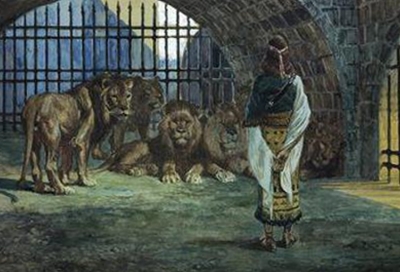
Apocalypse Prophecy XVII-Daniel and The Lion’s Den
Clearly this is one of the most popular and familiar stories in the Bible: Daniel in the lions’ den. The events occurred as the new government was being formed. Thus they must have taken place soon after Babylon had fallen to the Persians, likely within the first or second year (539–537 B.C.). By this time some Jewish captives had returned to Palestine under the leadership of Zerubbabel, and Daniel was probably over eighty years of age. Daniel the book introduces Darius the Mede as the leader of the new government in Babylon, and this king plays a prominent role in chap. 6. His identification has been the subject of much debate. The LXX translators substituted the name Artaxerxes for that of Darius in 6:1a (Eng. 5:31a), but the translation of Theodotion agrees with the Hebrew Masoretic text. Well, who is this Darius the Mede? It will suffice to say for this post that I sort of went over this in an older post called: Examining the Scriptures CXXI (go read it!). I will not be going into it again, as it is a long and convoluted explanation.
Anyway…
Regardless of the manner in which Daniel rose to power in the new administration [Daniel 6:3-ish], the man/leader named Darius was extremely impressed with him and planned to set him over all the other officials in the kingdom. Daniel had a proven track record, he had “differentiated himself” among the other officials because of his “extraordinary abilities,” literally, “An exceptional spirit was in him.” In the original language it literally said that Daniel “was continually distinguishing himself.” It is possible that the “exceptional spirit” may refer to his good attitude or abilities, but it is more probable that people around him recognized that Daniel was in touch God and thus possessed greater wisdom because of this.
Daniel then becomes the object of a plot to undermine him because the king planned to set Daniel over all the satraps and administrators, jealousy seems to overwhelm the others. They examine Daniel’s activities in order to discover some flaw in his character or professional ability in order to bring a charge against him to the king, but none was found. Many of the 120 satraps were not involved in this plot, and the number probably was limited to a small handful. However the texts seems to indicate that both of the other administrators did attempt to prevent Daniel from being appointed to this high position. The jealous officials decided that there was only one area in which they might find a conflict between Daniel and the Persian government, namely, in the area of his religion. They planned to ensnare him by forcing him to refuse to worship other gods.
The choice, would he be obey “the law of his God” or the law of man. Daniel’s religious convictions were not hidden. The prophet was not a secret disciple but a man who was not ashamed to let others know that his allegiance was to the God of Israel. It is clear from Daniel’s commitment that he would not compromise even in the face of punishment or death.
The treacherous administrators proposed that the king issue a decree, and strictly enforce it, that no one should pray to any god or man except the king for the next thirty days on penalty of death. Such a law might have been allowed for political reasons, and Darius may also have permitted a decree of this kind as a test of loyalty to his new government. We must note clearly here that Darius was not proclaiming himself to be a god but during this thirty-day period was acting as mediator for the gods of all the nations subject to him. Disobedience to the degree meant being thrown into a den of lions, where they would be torn to pieces and devoured. Such a gruesome death accurately reflects conditions the Assyrians and Persians employed this form of punishment in their kingdoms at the time. Once signed, Darius’s decree could not be “altered”. This was a common practice of the time also.
As we all know the story… when this law was passed, he did not change his religious behavior, nor did he hide it. Daniel was a man of courage and conviction who was willing to stand for God even if it meant death. As Daniel prayed three times a day, he continued to do so. The truth that Daniel deliberately defied a law of the land troubles some people. How can this action be reconciled with the biblical admonition in Romans 13:1–2? Simple… Scripture does indeed tell us to obey the government, BUT the Bible also teaches that there is a higher law—the law of God. There may be times when the law of the land and the law of God come into conflict. God trumps man in these situations!
So Daniel broke the king’s law before witnesses. Therefore the spineless wimp Satraps promptly reported that Daniel had violated the king’s command and attempted to put as bad a light on the situation as possible. They said Daniel “pays no attention” to the king, which means that Daniel did not consider the king important. Darius’s concern for his friend is touching. He shouted down to Daniel in the pit, “May your God, whom you serve continually, rescue you!”
A stone was placed over the opening of the den (Daniel 6:17-18) and sealed with the signet rings of the king and his nobles so that no one would dare attempt to rescue Daniel so that Daniel’s situation might not be changed. The practice was that soft clay was attached to the chains draped over the stone, and the king and his nobles made their personal marks (seals) by pressing their rings into the clay. After the clay hardened, the chains could not be removed without breaking the seals. Surely no one would attempt to remove the chain containing the names of the king and some of his highest officials. Daniel was now in the den, and all possibility of escape was cut off.
The king hastily returns to the opening of the den and cried out to Daniel in anguish and hope. The king’s actions demonstrate that he held out the hope that Daniel’s God could deliver him, but his “anguished” voice betrayed the fact that he did not believe it was likely. No one can visualize the great happiness and bewilderment that must have overwhelmed Darius when he heard the cheerful voice of Daniel reply, “O king, live forever!” Daniel explains to the king that God had sent his angel to protect him against the lions. . Now the king commanded that those who had “falsely accused” the prophet should be thrown into the den of lions.
The treachery is then returned to the others. Not only the conspirators but their families were thrown into the den of lions which was a Persian custom to prohibit retaliation from family members. The king was so floored by this miracle that he issued a public decree ordering all people throughout the “land” to give proper recognition to the God of Daniel. He decreed that people throughout his kingdom should “fear” and “revere” the God of Daniel. Amazingly, Darius a pagan kings proclaims that God is great because he protects rescues and saves his followers from harm and is able to perform great miracles.
The miracle the Lord had performed on earth was the rescue of Daniel “from the power of the lions.” Any God who is able to work this kind of miracle certainly should be feared. A God that can control the wild beast...and as we will see with Jesus, even the weather. It is here that we see the purpose of miracles is set forth in this passage. Miracles are not used by God to “show off” but to demonstrate to a lost world that he is the true God and should be honored.
February 7, 2012
Thought From Romans 3
Romans 3:3-4 ~What if some were unfaithful? Will their unfaithfulness nullify God’s faithfulness? Not at all! Let God be true, and every human being a liar. As it is written: “So that you may be proved right when you speak and prevail when you judge.” [Ps 51:4]
What is Paul saying here? Simple. When we as finite fallible humans put God to the test or question Him, He will pass the test. God is immutable therefore always faithful. When we see hardship in this life and attribute it to God not being faithful to us…we are dead wrong. Just the opposite is true. The truth is God never condones evil, BUT His punishment of sin is part of and a sign of His faithfulness…not a negation of it. The problem is that, from our messed up human perspective it looks as if God has abandon us when in reality He is literally right on top of us. In Psalm 51 it is clear God did not condone David’s unfaithfulness and sin as he was most certainly punished as was Bathsheba. What is also certain is that God did not withdraw His faithfulness from David. David hit rocky roads, yes, but on the long-term big picture David was treated rather well in his life and was rewarded in eternity. Just as we will be if we remain faithful to God as He remains faithful to us.
In the holistic picture of humanity we see that history itself is a trial by God to sharpen and shape the holiness of His entire Church. Which in the end will see faithfulness and final judgment and this will result in victory or defeat for every single individual that has ever lived. This means that God had to have had a plan laid-out ahead of time. If He had a plan it stands to reason that He chose people to certain things such as our salvation…
“And we know that in all things God works for the good of those who love him, who have been called according to his purpose. For those God foreknew he also predestined to be conformed to the image of his Son, that he might be the firstborn among many brothers and sisters. And those he predestined, he also called; those he called, he also justified; those he justified, he also glorified.” ~Romans 8:28-30
This is a reassuring thought for me considering how wretched I now realize that I am.
February 6, 2012
Apocalypse Prophecy XVI: Biblical Graffiti
King Belshazzar's Arrogance and Affront Against The Most High God (Daniel 5)
"King Belshazzar gave a great banquet for a thousand of his nobles and drank wine with them. While Belshazzar was drinking his wine, he gave orders to bring in the gold and silver goblets that Nebuchadnezzar his father had taken from the temple in Jerusalem, so that the king and his nobles, his wives and his concubines might drink from them. So they brought in the gold goblets that had been taken from the temple of God in Jerusalem, and the king and his nobles, his wives and his concubines drank from them. As they drank the wine, they praised the gods of gold and silver, of bronze, iron, wood and stone. Suddenly the fingers of a human hand appeared and wrote on the plaster of the wall, near the lampstand in the royal palace. The king watched the hand as it wrote. His face turned pale and he was so frightened that his legs became weak and his knees were knocking." ~Daniel 5:1-6
The Chaldean king Belshazzar made a feast to his chief officers, at which, in drunken arrogance, carried out a desecration of the sacred vessels which Nebuchadnezzar had carried away from the temple at Jerusalem, and by so doing he derided the God of Israel (vv. 1–4).
Then he suddenly saw the fingers of a hand (literally, back or palm of a hand) writing on the wall of the guest-chamber, which caused him to be agitated by violent terror, and commanded that the wise men should be sent for, that they might read and interpret to him the writing and when they were not able to do this, he became pale with alarm (vv. 5–9).
Then the queen informed him of Daniel, who would be able to interpret the writing (vv. 10–12)
Daniel, being immediately brought in, declared himself ready to read and interpret the writing; but first he reminded the king of his sin in that he did not take warning from the divine chastisement which had visited king Nebuchadnezzar (Dan. 4), but offended the Most High God by desecrating the holy vessels of His temple (vv. 13, 14).
He then interpreted to him the writing, showing the king that God, by means of the writing was ending his reign, and the transference of the kingdom to the Medes and Persians (vv. 25–28).
“But you, Belshazzar, his son, have not humbled yourself, though you knew all this. Instead, you have set yourself up against the Lord of heaven. You had the goblets from his temple brought to you, and you and your nobles, your wives and your concubines drank wine from them. You praised the gods of silver and gold, of bronze, iron, wood and stone, which cannot see or hear or understand. But you did not honor the God who holds in his hand your life and all your ways. Therefore he sent the hand that wrote the inscription. “This is the inscription that was written: MENE, MENE, TEKEL, PARSIN “Here is what these words mean: Mene: God has numbered the days of your reign and brought it to an end. Tekel: You have been weighed on the scales and found wanting. Peres: Your kingdom is divided and given to the Medes and Persians.” Then at Belshazzar’s command, Daniel was clothed in purple, a gold chain was placed around his neck, and he was proclaimed the third highest ruler in the kingdom. That very night Belshazzar, king of the Babylonians] was slain, and Darius the Mede took over the kingdom, at the age of sixty-two. Daniel 5:22-31
MENE, MENE, TEKEL, PARSIN normal noun meanings are weights and measures and on the surface were insignificant: "two minas - a shekel - two parts." In the verb form, they were: MENE, to number; TEKEL, to weigh; UPHARSIN, to divide—if read as verbs it means: "numbered, weighed, divided." The king had been weighed in the balance and found wanting. It is further ironic that God would use units of measure of wealth to be the words to undo and spell the demise of the most powerful man in the world up to the point. As we will see that will change immediately. Daniel was consequently honored by Belshazzar, who was, however, in that same night put to death (v. 29, 30) and Darius the Mede took over the kingdom that very night.
In the past, this narrative had presented some historical difficulties, for a Chaldean king by the name of Belshazzar was mentioned nowhere else, except in in Baruch 1:11, which itself cannot stand alone and is dependent on Daniel. Numerous suggestions have been offered to explain the specific father-son relationship between Nebuchadnezzar and Belshazzar noted in this chapter.
It is possible that in Hebraic thought the terms “father” and “son” in this passage mean that Nebuchadnezzar was the predecessor or ancestor or “father” of Belshazzar and that Belshazzar was Nebuchadnezzar’s successor, “son.” This parallel is also used in reference to Jesus being a Son of David and everyone knows David was not Christ’s biological Father…at least I sure hope they do if their theology is sound and intact.
“..But when the chief priests and the scribes saw the wonderful things that he did, and the children crying out in the temple, “Hosanna to the Son of David!” Matthew 21:15
“And as Jesus taught in the temple, he said, “How can the scribes say that the Christ is the son of David?” Mark 12:35
He called out, "Jesus, Son of David, have mercy on me!" Luke 18:38
“Son” is unquestionably used in Biblical text, as elsewhere, in the sense of “successor.” Likewise “son” does not have to mean an immediate offspring, grandson, descendant, or successor. The probable reason the intervening generations are negated or not mentioned is probably purposeful for contrast and for clarity to the Hebrew mind and therefore a studied astute Christian mind. This is also done to draw a direct correlation between two men of the same lineage but separated by a specific amount of time to draw emphasis to the relationship because only Nebuchadnezzar and Belshazzar are crucial to the story. Neb’s is the obedient pagan king and Belshazzar is the disobedient pagan king (a la Deuteronomy 28). Belshazzar should’ve learned the lesson from Nebuchadnezzar being the descendant but he was a hard-headed dope and ends up paying the price with his life.
As an apologist the two most important things to me is are (1) From a Spiritual Standpoint: The miraculous handwriting and Daniel’s interpretation of it are matters of faith (2) From a Evidential/Naturalistic Standpoint: The historical circumstances surrounding these events are established by objective data and are documented by archeology and historical records. We have a real God that enters real history and effects real people and it can be validated through real empirical archeological evidences and real historical documentation and/or artifacts.
The other thing that should be clearly noted here is the comment in verse 5, "Suddenly the fingers of a human hand appeared and wrote on the plaster of the wall, near the lampstand in the royal palace." To me this is a visual contrast thing. For those that doubt whether this actually happen we have the written testimony of Daniel actually reading the wall so it cannot be "chalked" up to Bellshazzar's imagination. What is interesting is that it is written on a plaster wall which more than likely was pale or white as it most probably was גִּירָ֕א or lime. If we compound this with the fact the writing of the hand took place near the lampstand tells me two things. One, there was plenty light to see the words and two the words would've probably been in relief because at the time, the Medo-Persian empire would've been used to seeing cuneiform and it is often God's insight an approach to use the things the current culture is used to, to convey meaning and intent. So the combination of the writing with the lampstand's light and would've probably appeared in contrast and rather ominous as below. Regardless, it had is desired effect...Belshazzar was terrified.
מנא ,מנא, תקל, ופרסין
Hence Bellshazzar's knees were "knocking".
One more thing that should be absolutely noted here is directed towards the Arminian / Calvinist debate tht has raged for centuries. The response to Belshazzar's actions are written on a wall by a disembodied hand. Daniel says the hand is an emissary from God. It can be interpreted as the 'hand of God'. Ironically, the very hand that holds Belshazzar's נִשְׁמְתָ֥ךְ breath or life in verse 23.
There are several references direct or indirect to God's sovereignty in Daniel. This one is profound and is a punch in the face (or should be for all who read it). There is reference to events in history being the result of the action of 'no human hand' in Daniel 2:45 & 8:25. Nebuchadnezzar is eventually brought to confess that the Most High rules and that 'none can stay his hand'. This must viewed as deterministic in history under the tight control of God.
Daniel's interpretation of the wall...“weighed in the balance and found wanting” especially the word “mina / numbered” should be understood to support this concept of God’s sovereignty. It conveys the idea that the length of Belshazzar's reign has been precisely and tightly determined by God. Belshazzar...the most power man in the world that night. Soon to be the deadest.
Conversely, while the Book of Daniel, clearly presents the sovereignty of the Most High God over human kingdoms and their rulers. There are clearly allusions like the one concerning Belshazzar that show he is not a puppet or robot of God. It is at the point where Daniel addresses Bells that he sounds most like a Hebrew prophet. His speech is pure hellfire and brimstone condemnation. There is no call to repent. There is no explanation of how the judgment coming for Bells can be averted. It is a death sentence.
Belshazzar is a “Deadman Walking”…his actions and attitudes have doomed him.
Belshazzar having been precisely weighed by a perfect God and found wanting shows that he (as are all of us) is (are) morally responsible for what happens to him (our) and his kingdom (our lives). This should be a startling wake-up call for us, not just Belshazzar. The irony is that the stark contrast in behavior to Bells resides in Daniel when it comes to proper behavior in the hand of a sovereign God. All in the same narrative.
February 4, 2012
Apocalypse Prophecy XV: Neb's Tree
Nebuchadnezzar's Second Dream (Daniel 4)
In the English translations, 4:1–3 serves as an introduction to chap. 4, whereas in the Aramaic they conclude Chapter 3. The English arrangement is preferred and it is generally recognized that these verses do, in fact, introduce Chapter 4. We see Nebuchadnezzar’s second dream and his third miraculous encounter with Israel’s God. Daniel did not date the dream and subsequent events described here, but they point to Nebuchadnezzar’s reign. His building have been concluded (4:30), there was peace throughout the empire (4:4). There are mentions to the king’s illness by Abydenus which was preserved by Eusebius and by a man named Berosus who was a third century B.C. Babylonian priest. The king’s illness appears to have begun a year after the dream and probably lasted seven years. Daniel would now have been about fifty years of age.
Daniel 3 is a proclamation by king Nebuchadnezzar to all the peoples of his kingdom, informing them of a wonderful event which the living God of heaven made Himself known as the ruler over the kingdoms of men. Neb’s makes known to his subjects he had dreamed a dream which filled him with uneasiness, and which the wise men of Babylon could not interpret, until Daniel came, who was able to do so. In his dream he saw a great tree, with vast branches and bearing much fruit, which reached up to heaven, under which beasts and birds found a lodging, shelter, and food.
A holy watcher (celestial being) came down from heaven and commanded the tree to be cut down, so that its roots only remained in the earth, but bound with iron and brass, till seven times shall pass, so that men may know the power of the Most High over the kingdoms of men. Daniel interpreted to him this dream, that the tree represented the Nebuchadnezzar himself, regarding whom it was resolved by Heaven that he should be driven forth from men. He would literally live among the beasts till seven times should pass, and he should know that the Highest rules over the kingdoms of men. After a year the dream began to be fulfilled, and Nebuchadnezzar fell into a state of madness, and became like a beast of the field. But after the appointed time his wits returned to him. He was again restored to his kingdom and became exceeding great, and now praised and honored the King of heaven.
This chapter is unusual in a number of ways. It contains some features similar to those of an epistle. It is the only chapter in Scripture composed under the authority of a pagan in that it is written from Nebuchadnezzar’s viewpoint. Daniel 4 is the king’s testimony of God’s operation in his life. A change from first person to third person and then back to first person happens here.
Yahweh had employed miracles in order to demonstrate his reality and power to Nebuchadnezzar. Not only the earlier fiery furnace episode, but even the experience related in this account was a wondrous sign to the king. We and Nebuchadnezzar see the divine dominion over all those in heaven and earth. God’s sovereignty and power are such that none can stay His hand. No one on earth has the wisdom or might to challenge the power or actions of the omnipotent and omniscient God. When Nebuchadnezzar repents God restored his kingdom and his honor, demonstrating the principle that God honors those who honor him. Nebuchadnezzar praised God for his greatness, power, and sovereignty. God’s amazing deeds had included a dream revealed and interpreted, three men delivered from a furnace and the removal and restoration of both
Nebuchadnezzar’s sanity and his kingdom. Nebuchadnezzar had finally come to his senses and realized that the God of Israel was the Most High God, not Nebs himself or the gods of Babylon. It was also vividly illustrated that his kingdoms as well as his lives could be taken away by the Lord at will. The king was now an old man and must have been very aware of his fragility. This recognition of the infinite realities is understandable considering the many ways in which God had demonstrated his reality and power to Nebuchadnezzar and the constant witness of Daniel in the court
The end of this chapter summarizes the moral implications nicely
“…and those who walk in pride He is able to humble” or the proverbial "pride goes before the fall".
Proverbs 16:18~Pride goes before destruction, a haughty spirit before a fall.
The king had learned a painful lesson. God hates pride and humbles those who will not acknowledge his sovereignty over them.
God’s concern for persons in every part of the world may also be observed here. Even in pagan Babylon there was a witness—spiritual light—to the power and reality of God…just as Christians are to be lights to the non-believers who dwell in darkness. God never wishes horrible experience on people but neither can God ignore or not judge sin—he gave Nebuchadnezzar a full year to repent. We see in God’s mercy and love the ordeal was permitted in order to bring the proud king to repentance.
February 3, 2012
Apocalypse Prophecy XIV: Where's Waldo...er...Daniel?
A Colossal Eyesore and Daniel’s Conspicuous Absence (Daniel 3)
"Nebuchadnezzar the king made an image of gold, the height of which was sixty cubits and its width six cubits; he set it up on the plain of Dura in the province of Babylon. Then Nebuchadnezzar the king sent word to assemble the satraps, the prefects and the governors, the counselors, the treasurers, the judges, the magistrates and all the rulers of the provinces to come to the dedication of the image that Nebuchadnezzar the king had set up. Then the satraps, the prefects and the governors, the counselors, the treasurers, the judges, the magistrates and all the rulers of the provinces were assembled for the dedication of the image that Nebuchadnezzar the king had set up; and they stood before the image that Nebuchadnezzar had set up. Then the herald loudly proclaimed: “To you the command is given, O peoples, nations and men of every language, that at the moment you hear the sound of the horn, flute, lyre, trigon, psaltery, bagpipe and all kinds of music, you are to fall down and worship the golden image that Nebuchadnezzar the king has set up. But whoever does not fall down and worship shall immediately be cast into the midst of a furnace of blazing fire...” ~Daniel 3:1-6
Right off the bat in verse 1 Nebuchadnezzar commanded a colossal golden image to be set up in the plain of Dura at Babylon, and summoned all his high officers of state to be present at its consecration. He caused it to be proclaimed throughout the land, that at a given signal all should fall down before the image and worship it. Those that refused to do so would be cast into a burning fiery furnace.
...and Daniel is nowhere to be found in this portion of a book that bears his namesake.
This ceremony having ended, it was reported to the king that Daniel’s friends, who had been placed over the province of Babylon, had not done homage to the image; whereupon, being called to account by the king, they refused to worship the image because they could not serve his gods. The guilty individuals were Shadrach, Meshach and Abednego. Because of this defiance to the king they were thrown bound in their clothes, into the burning fiery furnace.
They were unscathed by the immense heat of the flames; and the king perceived with terror that not three, but four men, were walking unbound and uninjured in the furnace (vv. 19–27). Then he commanded them to come out; and when he found them wholly unhurt, he not only praised their God who had so wonderfully protected them, but also commanded, on the pain of death, all the people of his kingdom not to despise this God (vv. 28–30).
It is quite probable that Nebuchadnezzar, after he had firmly established his world-kingdom by the overthrow of all his enemies, felt moved to erect this image as a monument of his great exploits and of his world-power; yet the destruction of the capital of Judea, which had been already twice destroyed, can hardly be regarded as having furnished a sufficient occasion for this as it was solely a small “backwater” in his empire. It would be like erecting a monument for conquering the Canary Islands.
It is probable that the king received the idea for the image from the dream in Chapter 2, and the likelihood that the image was constructed to test the loyalty of the king’s officials to his new administration all appear to support a time nearer the beginning of Nebuchadnezzar’s reign.
What is interesting about this narrative is that Daniel was not present on this occasion, and a number of explanations for his absence have been offered.
I believe the correct tact for figuring out where Daniel was is by understanding the statement made in Daniel 2:49: “Moreover, at Daniel's request the king appointed Shadrach, Meshach and Abednego administrators over the province of Babylon, while Daniel himself remained at the royal court”. They had been appointed to administer to the affairs of the province. Daniel on the other hand had responsibilities that actually required his presence at the palace. With the king and other important officials absent, someone would’ve been needed to govern in the city. Therefore Daniel wouldn’t have been able to leave Babylon and travel to the plain of Dura. Therefore, his absence may also have been due to other factors. The fact-of-the-matter is that judging by Daniels character elsewhere in the book named after him, Daniel would’ve never paid homage to a giant eyesore.
So what we see in this chapter is a demand of an earthly king to have people pay homage and loyalty to him but what we really see is a testament to the faith of 3 men that follow the One True God...the God of Heaven. For it is only the God of Heaven that could've spared Shadrach, Meshach and Abednego from the incinerating flames of the furnace.
On thing of particular note that should be mentioned about Chapter 3 is in verse 9-12:
They said to King Nebuchadnezzar, “May the king live forever! Your Majesty has issued a decree that everyone who hears the sound of the horn, flute, zither, lyre, harp, pipe and all kinds of music must fall down and worship the image of gold, and that whoever does not fall down and worship will be thrown into a blazing furnace. But there are some Jews whom you have set over the affairs of the province of Babylon—Shadrach, Meshach and Abednego—who pay no attention to you, Your Majesty. They neither serve your gods nor worship the image of gold you have set up.” Daniel 3:9-12
The astrologers addressed the king in the customary manner— “O king, live forever!” They then launch into the charges and reminded the king of his decree to worship the image and of the death penalty for refusing to comply. These sniveling astrologers bring to the kings attention that the disrespectful and treasonous men were “Jews.” There should've been no reason to point out their nationality. Therefore the designation seems slanderous and resentment toward Jewish people is evident. We are seeing anti-semitism here. Anti-Semitism is nearly always satanic in origin. This is especially true in the period before Jesus' birth as Satan clearly knew the Messiah would arise from the Semitic (Jewish) people. The Savior of all mankind (Gen. 3:15; Rom. 9:4–5) would be born of Jewish descendents.
The king was reminded that he had given these Jews positions of authority in his administration (“there are some Jews whom you have set over the affairs of the province of Babylon”). They were eithr trying to point out a Jewish rebellion or this was veiled assault on the king’s judgment—Nebuchadnezzar had made a mistake in assigning these foreigners positions in Babylon. Either way he was backed into a corner...at least it seemed so until Shadrach, Meshach and Abednego became immune to the effects of fire with the power of Alimighty God.
February 2, 2012
Apocalypse Prophecy XIII: Contexts, Parallels & Spirit of the Text
[Thus begins the specific interpretation of the text of Daniel. You are free to differ in opinion and I imagine many will do so.]
The Historical, Theological and Geographical Settings (Daniel 1:1-2)
Daniel 1:1-2 ~ In the third year of the reign of Jehoiakim king of Judah, Nebuchadnezzar king ofBabylon came to Jerusalem and besieged it. And the Lord gave Jehoiakim king of Judah into his hand, with some of the vessels of the house of God. And he brought them to the land of Shinar , to the house of his god, and placed the vessels in the treasury of his god.
Historically
It has been errantly stated that the opening statements in (v.1-2) supposedly create a chronological/historical problem that troubles people/commentators. Some have stated (including John Calvin) that Nebuchadnezzar is called king here in a proleptic manner (existing before his proper historical time). This is based on the comparison or dissimilarity between Daniel and Jeremiah, this though can be chalked up to the possible usage of the Babylonian dating system used by Daniel and the Egyptian used in Jeremiah when referring to Jehoiakim's reign (Lucas 50-51). Regardless, the stories are set during the Babylonian Exile. We see God's plan of unfolding events unfolding in the real world in real history (Lucas 52).
Theologically
It is theologically asserted or implied throughout Daniel that the Babylonian exile is not due to the inability ofGod to defend Jerusalem but it is actually due to a deliberate act by God to make it happen. So much for assumptions about God's plans and ability to do things...eh? In this case, God is working through Nebuchadnezzar and smashes Jerusalem in judgment . This is similar to God working to harden Pharaoh's heart centuries earlier during the time of the Exodus of the Hebrew slaves from captivity. We see this theological understanding of God: He allows or has events transpire in human lives that are not only historical but firmly based in God's sovereign control.
Geographically
The setting geographically and geopolitically...we see Babylonian incursion by siege warfare courtesy of Nebuchadnezzar intoJerusalem ruled by Jehoiakim. And God delivers Jerusalem to the Babylonians. From this point forward as the text says, the narrative will be based in Shinar and olden name for Babylonia .
Synopsis: God is a God of time and place therefore over Creation. He is also a God of Spirit and He is sovereign over all of them.
Daniel 2:1-49 Similarities to Genesis 41
The account of a slave or subservient brought before a ruler because his own, magicians, enchanters, sorcerers, astrologers or prognosticators cannot interpret the rulers dreams in Daniel 2:1-49 clearly parallels and is reminiscent of Joseph's interpretation of Pharaoh's dream in Genesis 41 and then is given position of second only to Pharaoh, although this should not just be considered a retelling of the same type of tale. Specifically the the parallels zero in on Genesis 41:8 verb usage being the same as Daniel 2:1 when used in reference to Pharaoh's and Nebuchadnezzar's "spirit[s] were/was troubled" . The subject similarities are basically (1) A king is worried by his dreams ad gets irate when his wise men cannot decipher it (2) A young Israelite exile is found who can (3) The young Israelites insists this ability is from God who is really the One worth of the king's praise (4) The dream(s) concern a future event. (5) the king promotes the young man to a position of honor. A noted difference though is that Daniel only interprets the dream, he does not offer advise as Joseph did.
We see the categorization of "court tales" acted out here. We should more properly see this as a court contest centering around interpretation of a dream as the mitigating factor. The following syllogism (loosely) outlines the court tale: (1) Sage acts as primary entertainer for king but sometimes must solve more vexing problem for ruler (2) Supposed wise courtiers shown to be bumbling idiots. (3) Sage on deathbed may impart words of wisdom (4) Sage may act as savior delivering King from vexation (5) Sage may experience disgrace followed by restoration.
What's Important? The Dream or The Story Itself?
The main point of the story is carried in the narrative...the dream is secondary to the narrative. The "mystery" it reveals is not the details of the course of events of history but the fact that history is under the control of God and that it has a purpose which will be achieved.
The narrative is a story of six acts. (1) Sages failure to interpret dream (v1-13), Daniel seeks and obtains dreams content from God (v14-23) (3) Daniel witnesses to the God who reveals mysteries (v24-28a), (4) Daniel recounts dream (v28b-35) (5) Daniel interprets dream (v36-45) (6) Nebuchadnezzar honors Daniel and his God (v.46-49). The irony in the whole storyline appears to be that Daniel essentially concurs with the court sages (v.27) conclusion that no man could possibly know what the king asks of them (v10-11) and this is exactly the point of entry and the statement about a God who can. A divine, sovereign and omniscient God who can reveal knowledge / wisdom / answers to mysteries unknown to men because He is sovereign and omniscient. The reason this happens is to ultimately bring glory to God because it shows nothing is hidden to Daniel's God and there is nothing He does not understand. Ultimate sovereignty and omniscience is in God's hands. This is great comfort to those who are about to or are currently undergoing persecution or suffering because they/we know that God is aware of what we are going through and what is happening to us and if He knows this and is sovereign... then He is allowing it for a reason (Andy's Note: this concept would then underlie some of the explanation for Theodicy).
Daniel's God: 1
Chaldean's god(s): 0
The Historical, Theological and Geographical Settings (Daniel 1:1-2)
Daniel 1:1-2 ~ In the third year of the reign of Jehoiakim king of Judah, Nebuchadnezzar king of
Historically
It has been errantly stated that the opening statements in (v.1-2) supposedly create a chronological/historical problem that troubles people/commentators. Some have stated (including John Calvin) that Nebuchadnezzar is called king here in a proleptic manner (existing before his proper historical time). This is based on the comparison or dissimilarity between Daniel and Jeremiah, this though can be chalked up to the possible usage of the Babylonian dating system used by Daniel and the Egyptian used in Jeremiah when referring to Jehoiakim's reign (Lucas 50-51). Regardless, the stories are set during the Babylonian Exile. We see God's plan of unfolding events unfolding in the real world in real history (Lucas 52).
Theologically
It is theologically asserted or implied throughout Daniel that the Babylonian exile is not due to the inability of
Geographically
The setting geographically and geopolitically...we see Babylonian incursion by siege warfare courtesy of Nebuchadnezzar into
Synopsis: God is a God of time and place therefore over Creation. He is also a God of Spirit and He is sovereign over all of them.
Daniel 2:1-49 Similarities to Genesis 41
The account of a slave or subservient brought before a ruler because his own, magicians, enchanters, sorcerers, astrologers or prognosticators cannot interpret the rulers dreams in Daniel 2:1-49 clearly parallels and is reminiscent of Joseph's interpretation of Pharaoh's dream in Genesis 41 and then is given position of second only to Pharaoh, although this should not just be considered a retelling of the same type of tale. Specifically the the parallels zero in on Genesis 41:8 verb usage being the same as Daniel 2:1 when used in reference to Pharaoh's and Nebuchadnezzar's "spirit[s] were/was troubled" . The subject similarities are basically (1) A king is worried by his dreams ad gets irate when his wise men cannot decipher it (2) A young Israelite exile is found who can (3) The young Israelites insists this ability is from God who is really the One worth of the king's praise (4) The dream(s) concern a future event. (5) the king promotes the young man to a position of honor. A noted difference though is that Daniel only interprets the dream, he does not offer advise as Joseph did.
We see the categorization of "court tales" acted out here. We should more properly see this as a court contest centering around interpretation of a dream as the mitigating factor. The following syllogism (loosely) outlines the court tale: (1) Sage acts as primary entertainer for king but sometimes must solve more vexing problem for ruler (2) Supposed wise courtiers shown to be bumbling idiots. (3) Sage on deathbed may impart words of wisdom (4) Sage may act as savior delivering King from vexation (5) Sage may experience disgrace followed by restoration.
What's Important? The Dream or The Story Itself?
The main point of the story is carried in the narrative...the dream is secondary to the narrative. The "mystery" it reveals is not the details of the course of events of history but the fact that history is under the control of God and that it has a purpose which will be achieved.
The narrative is a story of six acts. (1) Sages failure to interpret dream (v1-13), Daniel seeks and obtains dreams content from God (v14-23) (3) Daniel witnesses to the God who reveals mysteries (v24-28a), (4) Daniel recounts dream (v28b-35) (5) Daniel interprets dream (v36-45) (6) Nebuchadnezzar honors Daniel and his God (v.46-49). The irony in the whole storyline appears to be that Daniel essentially concurs with the court sages (v.27) conclusion that no man could possibly know what the king asks of them (v10-11) and this is exactly the point of entry and the statement about a God who can. A divine, sovereign and omniscient God who can reveal knowledge / wisdom / answers to mysteries unknown to men because He is sovereign and omniscient. The reason this happens is to ultimately bring glory to God because it shows nothing is hidden to Daniel's God and there is nothing He does not understand. Ultimate sovereignty and omniscience is in God's hands. This is great comfort to those who are about to or are currently undergoing persecution or suffering because they/we know that God is aware of what we are going through and what is happening to us and if He knows this and is sovereign... then He is allowing it for a reason (Andy's Note: this concept would then underlie some of the explanation for Theodicy).
Daniel's God: 1
Chaldean's god(s): 0
Winner: Daniel's God hands down.
February 1, 2012
Apocalypse Prophecy XII: Dating Daniel & The Theme
![]() |
| February 31, 1869 |
Except for negligible ancient sources, according to the epilogue in the text, it was generally agreed in antiquity that Daniel is the product of the 6th century BC. This date was not seriously called into question until the 18th century. My guess is that this was mitigated by literary criticisms and liberal theologians with anti-supernatural presuppositions that presupposed a naturalistic explanation. It was/is claimed by some “experts” that there are historical inaccuracies in Daniel in terms of dating and is therefore subject to question and its inerrancy is put into sharp scrutiny. The incidents documented in Daniel that count against Daniel supposedly being the work of an author that wrote during the 6th century are as follows: (1) The reference in Daniel 1:1-2 notes a siege of Jerusalem by Nebuchadnezzar in the third year of Jehoiakim. (2) Chapters 2 and 7 infer existence of a Median Empire between the Babylonian and the Persian –and- (3) Chapter 5, Belshazzar is given the title king and Nebuchadnezzar is supposedly his father (4) Daniel 5:31; 6:28, and the figure of Darius the Mede. The text then goes on to state that there is no conclusive evidence of historical inaccuracy an therefore these criticisms are “not proven”. (Lucas 307).
Some scholars suggest that the dating is subject to error because of what it calls “Linguistic arguments”. This argument in my mind carries more weight. The Persian words presuppose a period after the Persian empire had been well established just as Greek words demand Greek power or influence. As for Daniel we see Aramaic and Hebrew material. History being reflective can now see that Aramaic used in Daniel is the Aramaic used from 700-200 BC. This is different from the Qumran Aramaic used between 200 BC to AD 200. On the other hand the Hebrew of Daniel is more similar to Ezra, Nehemiah and Chronicles than exilic Hebrew of Ezekiel. There are clear differences between Ezekiel and Hebrew of Daniel. The bottom-line is that the language used in Daniel lends itself to as early a date as the 6th century but according to (P.312) the wordage does not totally preclude a later date no matter how improbable a later date might be. Regardless, the dates should never be a factor for discounting divine inspiration as noted below.
If there is a question of date of writing, is the divine inspiration of Daniel in doubt at all? Of course not! The only people that question the divine inspiration of Daniel and doubt its inspiration are those that have a presupposition or bias to do so in my opinion. If a person comes to the Scripture looking for error that is what they will find and rarely will they attribute that error or “contradiction” to their own flawed or bias hermeneutical grid. If dating is so perfect why do we have a calander now..today in 2012 that has an error correction built right into it (its called leap year?). This issue is a post within itself that also dates back as far as the Babylonians. We cannot allow human inability to date things properly to prevent us from adhering to Scriptural inerrancy. So yes, dating can raise the specter of doubt but my question back to the person who asks this is: “Whose doubt does it raise?” We Christians are a people of faith and as such we should always approach Scripture the way Christ would, not the way a cynical and skeptical culture would. We must assume inerrancy if God is truly omnipotent and sovereign (which I believe He is!)
The truth is this:
The criticality in terms of divine inspiration of prophecy does not necessarily lie within pinpointing exact dates as mentioned within the forth-telling and foretelling question. The theological implications lie within the fact that God delivers prophecy as a tool or knowledge to His faithful. They are for people to make decisions at the point of prophecy calling them to faith immediately, not necessarily predicting things “down the road” for the unfaithful as punishment. God is not giving us prognosticators so much as he is trying to warn and instigate procrastinators.
It’s not how the message is given so much as it is the way it is interpreted and applied in a pragmatic manner both can be the product of divine inspiration….giving (prophecy) and receiving (Holy Spirit) (Lucas 309).
Ay! I love subtleties in wordage!
So the central theme running through the book of Daniel based on the information above was sort of answered already. The central theme is the sovereignty of the God of Israel (an ironically us too). Above all we must look at Daniel in the context of the entire Bible and its relation to the rest of Scripture. Scripture does not exist in a void and it is best when Scripture interprets Scripture. As such, the underlying passive and active agent in Daniel (and the Bible overall) is Almighty God. All the variables, aspects, perceptions and presuppositions of time and human subjectivity must be put on pause when we understand that God is in control of all things…and that is the point. Not only was Daniel a divinely inspired/authored book, so too is its interpretation and reading...divinely inspired. God influenced the input and he most certainly influences the output or discerning of Scripture as noted in places like 1 Corinthians 2:14-15, John 14:26, and 1 John 2:27.
Just as God encouraged Jews to interact with the pagan world in Daniel, God seems to reach across time to ask us to do the same in our reading of Daniel. Just as God is seen working through the pagan rulers of Daniel’s time, so to we see the possibility of the same happening to us now. Regardless, the implications and applications may differ person to person or age to age but the immutability and unchanging nature of God remains as does His sovereignty over all...for all of time.
Subscribe to:
Posts (Atom)